As a student of history I know that all societies create a system of education to store, generate and pass on the reservoir of knowledge to perpetuate themselves; a corollary of the individual’s instinct of self-preservation. Survival in a social habitat includes, as part of its package, learning by association. A natural adjunct is a sense of history as social memory, identifying friends and foes: climatic, vegetate, animate and human as individuals, groups and states.
Societies acquire a persona which we call culture or civilization, that demands commonality of living practices, social norms and ethical/moral values. Again, history tells us that invariably a society or community will build an education system to transmit this heritage. More often than not, these systems are based on a religious cosmology of the meaning of life and the pragmatic assessment of life choices in the human and natural elements present in a habitat/environment.
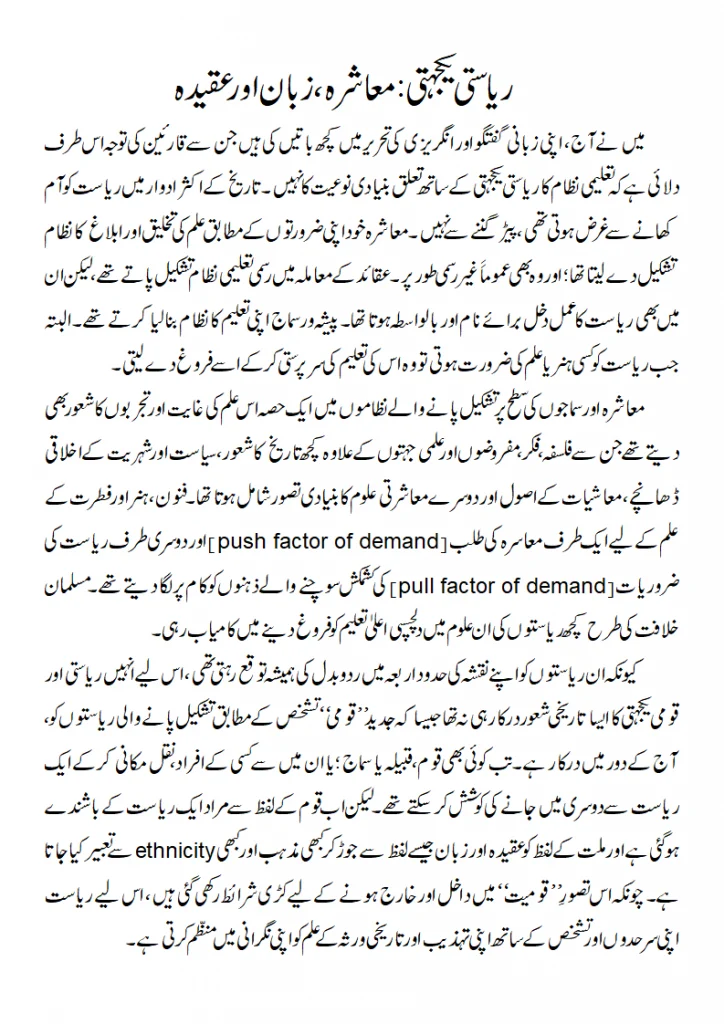
When Europe’s historical experience led it to the formation of nations and states, it began to look for a system to suit the need for a shared history in a disjointed past. A history book written a hundred years ago by Keith Feiling shows how this was done for the history of England. The fact that it was still a prescribed reading forty years ago, illustrates that not much was added to the repertoire in sixty odd years. But here we need to focus on the idea of secondary education and the nation state. Secondary education is the level at which the state now needs to integrate its citizens. The shared heritage and the fusion or synthesis of the diverse values and elements that go to make a nation in modern times is achieved at this stage of the child’s life.
The English forced their language on Scotts, Irish and Welsh by denying them service with the state after they had been conquered. Overseas colonization made this policy a bargaining chip which served to integrate the diverse population because of shared colonial wealth. Jutes, Picts, Gaelic speaking Scotts, Celtic languages of the western parts of the Isles that became Britain, all had to bow to the Anglo-Saxon dictate and speak the “King’s English”.
But let me not digress too far in the reminiscence of how language and culture of the dominant population has dominated European nationalism. Returning to the point, national integration in this age is achieved through the “national narrative” which is indoctrinated in secondary school. Now, in Pakistan, given the cultural diversity, a core syllabus of ideology and the social ethics of civic rights, duties towards the state and law of the land would be one aspect of curricula at this stage. The other side is the essential grounding for higher education. Since the social side is covered in the core syllabus, basic scientific knowledge for a modern age must be added.
The transition to the national language [Urdu] and the international language [English] should be achieved at this level. Students should be allowed to choose the medium of instruction based on their expertise and willingness to learn. On one side, the choice could affect the success rate of students in the learning process; on the other, it could impact on their opportunities or career path, depending on other factors such as the variety of institutions of higher learning.
Some years ago, a serious effort was made to equalize the playing field for education of science disciplines. Preparation of high quality text books in Urdu and translation of high quality books on technical subjects was taken up as a state concern but soon the magnitude of effort that the faculty would have to put in proved a stumbling block; and the project was abandoned.
Just as, in the case of primary education, a pragmatic approach was needed to facilitate students, so, for secondary education and beyond, we need to be practical. Dissociating the issue of the script from the choice of vocabulary, we should rely on the elasticity of the Urdu language to accommodate new words. Terms in English have been absorbed in the past and are being taken up in our daily communication as a matter of course; there is no need to fight this trend.
If then the syllabi and curricula are identical, the gap between those educated in one medium and the other will merely be one of script. The pronunciation will be only marginally different between groups from various schools or social backgrounds and the intelligent student will be able to transit from one script to another, as do so many Pakistanis in their use of the internet. Consequently, the merger of intelligent students in institutions of higher learning will become an easy option regardless of the change of medium of instruction. But, for this teaching in Urdu at the higher secondary and undergraduate levels will need to be improved dramatically.